The only thing that we can do ultimately is die- said my advisor.That way we dont take up the oxygen due to others .
Graphic but true.
Every time I try to be GOOD I am in trouble.
I wonder if using less paper or closing my tap or not drinking coke will ever make a difference out there.Or is it only for me to feel good.
I am going to look for an answer in the Buddhist tradition because compassion is their forte.
Let you know more next post
Wednesday, September 13, 2006

Monday, September 11, 2006
Creativity and Verrier Elwin
This is an assignment I did for a class and I think I will publish it.
On
Verrier Elwin’s Autobiography which is called “The Tribal world of Verrier Elwin- An Autobiography”.
"The Tribal World of Verrier Elwin is the story of one of the greatest scholars and champions of India's tribal peoples. The hugely controversial Elwin's moving autobiography received the Sahitya Akademi award, which noted its 'sincerity', courage and charm, revealing a mind in which Western and Indian idealism were uniquely blended”.
- from the Vedam books website review of the book
The Book and Me!
When I was living in the Himalayas without so many modern comforts that we take for granted in the modern world, a visitor to the ashram mentioned Verrier Elwin’s name and told me I was trying to be one.
What was a Verrier Elwin?
I saw a book by Ram Guha on him but somehow I never got the inclination to read it . A few days ago in one of Bangalore’s book fairs I picked up an oxford ‘three in one’ classic paper book called “Lives in the Wilderness”. Since I was doing something on nature, I thought I could make this book a part of my background reading!
Creativity and Verrier.
In science, creativity is linked to discoveries and invention which like all definitions narrows down the scope of what one can call creative. But my take on creative thinking is that one can live life as a creation. To actively take on a set of values that you have to invent and reinvent every moment in your life is living a life in creativity. Creative thinking comes from a way to transform what is given –circumstances, events or data into something beyond -a new paradigm of living itself. Verrier’s life exemplifies this transformation.
At the same time Verrier is also an acclaimed writer with many books to his credit. His Autobiography is a pleasure to read with the right mix of humour and serious thought. I can see both creative and critical thinking in his work. I enjoyed reading the book and hope that some or the other time all of you will flip through the original. There are also small poems, parts of letters translations of tribal song and pieces of prose by other writers. This is a story as interesting as the narratives of tribals themselves. The autobiography is anecdotal so you can read bits and pieces in the middle if you like.
My story of Verrier’s story that I read.
What is a Verrier?
A Trishanku who found his heaven
They talk of suspension between two worlds- a Trishanku.
A verrier who was Elwin was born in Britain,
baptised by the church,
a bishop he was
till he came
to our world, India.
Where touched by Bapu-
a vishvamitra of satyagraha,
he began his ascent into worlds
that he didn’t belong in.
Writing a summary of an autobiography is somewhat of a challenge because the moment you put your words on paper, the book is transformed from an autobiography into a biography. If you use the author’s words exactly the way he used them, the summary becomes a long quotation, with no reference to context. Instead what I choose to do in this piece of writing is to tell a story of Verrier Elwin in my words after reading from the book. And because this is a book project, I will try and mention those ideas or quotations from the book that I liked. I also will try to trace from the story the answer to the question-“what made Verrier Elwin a creative person?” -creative as I described earlier, in the meaning of causing a transformation, creating a new vision where none was before.
If there is one thing I want to take on from this book it is the performs into city offered for a book supposedly written by a famous anthropologist not once did I have to look up a word in a dictionary or ponder or the right meaning of a technical term in anthropology . I was surprised at the ease with which I could read the book. This book is not to be thread for its profound insides of analysis instead it is a voyage of discovery of a human being in search of truth, beauty and love. The best part is he had a good time during this voyage.
Some places in the book you can see the writer is old and he wanders off from the serial relating of events and then comes back to the point again and resumes his narration.
Verrier quite simply tells us the story of his life .
Childhood
Verrier writes of his childhood in a Christian evangelist family. Two chapters of his autobiography cover his childhood and youth in England. He spares no time whining about hard times but easily writes of poverty, loneliness and his childhood struggles which taught him not to expect anything in life. He did have many people connected in many ways to India. Verrier was born in Dover, Kent in 1902 as the son of a bishop. The adult Elwin looks back to see the significance of this day –
“ a day which is tragically associated by the church with the beheading of John the Baptist and the birthday of King Herod,…..”.Three paragraphs into the episode of his birth, you can see how the writer will tell his story.
Of his parents, he was closer to his mother as his father was often away on tours. His mother is describes by Verrier as ‘intelligent, beautiful and imaginative but afraid of boredom’. After his father's death, Verrier’s mother turned to a livelier form of the Anglican Church revivalist evangelism. This provided his mother a chance of speaking with tongues or dancing in ecstasy near the holy table as opposed to the more staid Anglican Church Christianity. This stream of Christianity was sterner about sin and the pleasures of flesh and was almost ascetic in its practices.
Because of this religious fervor, the element children, Verrier his sister, and brother had to forgo many of the pleasures that accompany normal childhood. There was always the chance of a visitation from Jesus, what if he arrived during a play or a show?
Many interesting relations on his mother’s side gave his family shelter and took care of the needs of the mother and her children. Right here, his religious upbringing comes into conflict and causes him trouble. Would his grandmother, who was generous with pocket money, go to hell because she took swigs of brandy from a hidden bottle in her dress cupboard? Verrier mentions that many of his relations lived and worked in India.
Verrier claims that his childhood was not easy but he was happy. His adventures and learning in school were instrumental in giving him experiences that may be a different school could have done differently. All the limitations in his life actually taught him not to expect anything and so he says that later on he was able to be grateful to life when anything nice happened to him.
His love for writing and poetry had its roots in his student life when he opted to study English literature which was still a new field of study.
Youth
Verrier went to Merton College in oxford. He won many scholarships and prizes which he mentions rather casually in his autobiography. Instead, descriptions of people he met or was influenced by, books and landscapes of college life find centre stage in his prose.
The delightful story of Sir Herbert, the snobbish president of Magdelen College and Mrs Beasent must be retold. This story was making the rounds of colleges in oxford along with others about the snobbery when Verrier first heard it. Mrs Beasent came to have Krishnamurti admitted in the college. Seeing that Sir Herbert was reluctant, she remarked that her ward was special.” But my ward is a special person ”.she is said to have said ,”But he does happen to be the Son of God”. Sir Herbert is said to have replied to this “Madam we have the sons of many distinguished people in this college.”
Verrier however limited by the demands of his faith had few indulgences but poetry. After some unsuccessful attempts at boxing and soccer, Verrier took up religion as a pastime. “In place of bridge or racing” he writes.
He also recounts taking Dr Radhakrishnan out punting and asking him if he knew anything about comparative religions.
Following what could be termed as an ideal career path, he was offered a job as the vice principal of Wyncliff Hall and was made a chaplain too. But his dabbling in all kinds of literature meant his discussions were tending towards Catholicism and mysticism and soon he lost his job. His plans to take up work among the poor of London also fell through. We find an Elwin, poor without a job, unsure of the practice of his faith and unable to even follow the yearnings of his heart to serve the poor as a spiritual leader. In course of this time he was also fortunate to meet a Ceylon missionary called Bernard Aluvihare. Bernard not only introduced him to the real Asia but also kindled his interest in the Indian nationalist movement and philosophy. Verrier claims that Bernard was an antidote to his notions of Asian who he believed were “Wogs and Natives” As if all circumstances coming together, at this time that he heard of a movement called Christa Seva Sangh being run by a Father Winslow.
This was looking at reorienting Christianity in such a way to reconnect to the poor and also the cause of Indian nationalism and culture. Verrier was inspired by the thought of this novel experiment in living a different life and he along with others decided to join this order and move to India.
India of Gandhi
After a visit to Ceylon, Verrier landed in beautiful Malabar and was stuck by the beauty of the landscape. He arrived in Pune in 1927 and joined the Christha Seva Sangh. For Verrier,by the standards of 1927, the life at CCS was odd for an Englishman. They had Indian Food served to them in brass plates and katories.
They had to eat from them sitting crossed legged on the floor every meal. The dress was a Kadhi Habit.and the inmates had to learn Marathi.
An important event in the year 1928 for Verrier was his first visit to Sabarmati ashram and close contact with Gandhiji. He went there to attend an interreligious conference organised by B.P Wadia. In Verrier’s own words-
“From The moment of my arrival there I was doomed” he writes, “for long I was a sympathetic fellow traveler , now I became an ardent disciple”
It was during that visit that something transformed in the British born priest. Verrier the Indian was born. Very often in his autobiography, he keeps recollecting the various experiences he had during this time, and of Gandhiji influence on his life.
Unfortunately Verrier fell sick the same year with acute dysentery, and had to go back to England for convalescence. During this time Verrier produced small books on his faith and mysticism. But as soon as he was well enough he came back to India with a stopover at Palestine.
A few months after Verrier’s arrival, Father Winslow, left him in charge of the Ashram with slightly unpleasant consequences. Verrier’s association with the Indian National Movement and other Gandhians, and their stay at the C.S.S. led him into confrontations with the Clergy and the British government. He was reprimanded by his superiors in the church and he began to dissociate form the CSS from 1928-32, while remaining in close touch with Gandhi.
Verrier narrates for us the events of our own history. Strangely I did not find the narrative British. What is also refreshing in this account of this time is that there is frank respect and adoration of Gandhiji without it becoming a sheepy- dog- eyed worship. Elwin doesnot agree to Gandhiji’s views on puritan life. During this time Gandhiji asked him to go and work among the poor and the villages. When he was ready to do so and discussing various possibilities, Sardar Patel laid the first stepping stone of his life’s purpose by advising him to leave villages alone and instead to work with the tribals. His friend Shamrao, another priest from England joined him in Poona and the two embarked on a tour of tribal India. The individual history of Verrier gets enmeshed with the histories of the independence struggle around this time. It was during one such period that J. Bajaj asked Elwin to take a turn as President when it was the turn of an Englishman to occupy it.
This spurred Elwin into his own “true path” and he turned to his plan to work in the Gond area. There on the mud floor of small hut with a thatch roof, he fell again for the call of the primitive world. “In that little good shed I realized I would be able to escape the call of the (modern) primitive world.
Tribal India
Verrier’s autobiography moves into a realm where I cannot tell the story any better except in his own words.
He consequently broke away from the church when they refused to support the cause of a free India preferring instead to remain loyal to the colonisers. It was very painful time during Verrier’s life as he struggled to find a place for his faith without being disloyal to his religion. It was harder as the church preferred to be loyal to the colonizers rather than the people it served and for Elwin this was against the very spirit of Christianity. Verrier also began his crusade against Puritanism in any form as it seems to make the tribals in to wrongdoers just because of their freer ways of living. His differences with Gandhiji’s views on this too become evident.
Verrier spent his time moving from tribal village to tribal village, living with the tribals and serving them. Taking on a self imposed vow of poverty and service, he and his friend biut themselves a camp home in sachrwanchapar. Verrier began to document the tribal life in its entirety while still engaging in serving them. He calls this Philanthropology. What is Verrier’s autobiography is also the biography of the tribes he studied. There are stories of the people he met ,the land and forests he lived in as well as his own life. Every detail is alive and brought to the reader ,whether it is a Ghotul ( Community house) of the tribals or the leper’s ashram set up by him for the tribes.
Fact is woven into poetical fact and his passion and love for the people that he worked with shows itself through every time, whether it the boy who liked to kiss the radio set or the poor tribal Gonds in the jail, their ‘eyes like frightened deer’. The chapters that follow on Elwin’s life cannot be easily paraphrased without losing their charm and poetry. He traveled the central Indian regions with the Gonds, Santhaals and the Marias. He also spent time in the North east visiting many tribes.Many times he was sick and unwell yet he never let go of an opportunity to visit any last inhabited tribal settlement. The ministry of home affairs gave him a consultant position on tribal issues. During the course of his life he wrote many books documenting the life of tribals and translating their songs and myths .This autobiography was published three months after he passed away.
I will be reading bits of this part of his story for my presentation hence I choose not to write it all down here.
Journey’s end
Verrier’s eternal quest he says was love truth and beauty. He claims in his book that he found them in the simpler joys of life- his family, the tribal way of life and his friends. To him, love illuminates knowledge .His last chapters are philosophical in the sense that he seeks to define the meaning of his life and wishes the reader to take away one central message from his life. This is the message of compassionate love. Not an abstract love but love in action.
I conclude this story with his message-
“Love and the duties it imposes is the real lesson of the forest”.
I plan to next read Guha's book on Verrier elwin.
On
Verrier Elwin’s Autobiography which is called “The Tribal world of Verrier Elwin- An Autobiography”.
"The Tribal World of Verrier Elwin is the story of one of the greatest scholars and champions of India's tribal peoples. The hugely controversial Elwin's moving autobiography received the Sahitya Akademi award, which noted its 'sincerity', courage and charm, revealing a mind in which Western and Indian idealism were uniquely blended”.
- from the Vedam books website review of the book
The Book and Me!
When I was living in the Himalayas without so many modern comforts that we take for granted in the modern world, a visitor to the ashram mentioned Verrier Elwin’s name and told me I was trying to be one.
What was a Verrier Elwin?
I saw a book by Ram Guha on him but somehow I never got the inclination to read it . A few days ago in one of Bangalore’s book fairs I picked up an oxford ‘three in one’ classic paper book called “Lives in the Wilderness”. Since I was doing something on nature, I thought I could make this book a part of my background reading!
Creativity and Verrier.
In science, creativity is linked to discoveries and invention which like all definitions narrows down the scope of what one can call creative. But my take on creative thinking is that one can live life as a creation. To actively take on a set of values that you have to invent and reinvent every moment in your life is living a life in creativity. Creative thinking comes from a way to transform what is given –circumstances, events or data into something beyond -a new paradigm of living itself. Verrier’s life exemplifies this transformation.
At the same time Verrier is also an acclaimed writer with many books to his credit. His Autobiography is a pleasure to read with the right mix of humour and serious thought. I can see both creative and critical thinking in his work. I enjoyed reading the book and hope that some or the other time all of you will flip through the original. There are also small poems, parts of letters translations of tribal song and pieces of prose by other writers. This is a story as interesting as the narratives of tribals themselves. The autobiography is anecdotal so you can read bits and pieces in the middle if you like.
My story of Verrier’s story that I read.
What is a Verrier?
A Trishanku who found his heaven
They talk of suspension between two worlds- a Trishanku.
A verrier who was Elwin was born in Britain,
baptised by the church,
a bishop he was
till he came
to our world, India.
Where touched by Bapu-
a vishvamitra of satyagraha,
he began his ascent into worlds
that he didn’t belong in.
Writing a summary of an autobiography is somewhat of a challenge because the moment you put your words on paper, the book is transformed from an autobiography into a biography. If you use the author’s words exactly the way he used them, the summary becomes a long quotation, with no reference to context. Instead what I choose to do in this piece of writing is to tell a story of Verrier Elwin in my words after reading from the book. And because this is a book project, I will try and mention those ideas or quotations from the book that I liked. I also will try to trace from the story the answer to the question-“what made Verrier Elwin a creative person?” -creative as I described earlier, in the meaning of causing a transformation, creating a new vision where none was before.
If there is one thing I want to take on from this book it is the performs into city offered for a book supposedly written by a famous anthropologist not once did I have to look up a word in a dictionary or ponder or the right meaning of a technical term in anthropology . I was surprised at the ease with which I could read the book. This book is not to be thread for its profound insides of analysis instead it is a voyage of discovery of a human being in search of truth, beauty and love. The best part is he had a good time during this voyage.
Some places in the book you can see the writer is old and he wanders off from the serial relating of events and then comes back to the point again and resumes his narration.
Verrier quite simply tells us the story of his life .
Childhood
Verrier writes of his childhood in a Christian evangelist family. Two chapters of his autobiography cover his childhood and youth in England. He spares no time whining about hard times but easily writes of poverty, loneliness and his childhood struggles which taught him not to expect anything in life. He did have many people connected in many ways to India. Verrier was born in Dover, Kent in 1902 as the son of a bishop. The adult Elwin looks back to see the significance of this day –
“ a day which is tragically associated by the church with the beheading of John the Baptist and the birthday of King Herod,…..”.Three paragraphs into the episode of his birth, you can see how the writer will tell his story.
Of his parents, he was closer to his mother as his father was often away on tours. His mother is describes by Verrier as ‘intelligent, beautiful and imaginative but afraid of boredom’. After his father's death, Verrier’s mother turned to a livelier form of the Anglican Church revivalist evangelism. This provided his mother a chance of speaking with tongues or dancing in ecstasy near the holy table as opposed to the more staid Anglican Church Christianity. This stream of Christianity was sterner about sin and the pleasures of flesh and was almost ascetic in its practices.
Because of this religious fervor, the element children, Verrier his sister, and brother had to forgo many of the pleasures that accompany normal childhood. There was always the chance of a visitation from Jesus, what if he arrived during a play or a show?
Many interesting relations on his mother’s side gave his family shelter and took care of the needs of the mother and her children. Right here, his religious upbringing comes into conflict and causes him trouble. Would his grandmother, who was generous with pocket money, go to hell because she took swigs of brandy from a hidden bottle in her dress cupboard? Verrier mentions that many of his relations lived and worked in India.
Verrier claims that his childhood was not easy but he was happy. His adventures and learning in school were instrumental in giving him experiences that may be a different school could have done differently. All the limitations in his life actually taught him not to expect anything and so he says that later on he was able to be grateful to life when anything nice happened to him.
His love for writing and poetry had its roots in his student life when he opted to study English literature which was still a new field of study.
Youth
Verrier went to Merton College in oxford. He won many scholarships and prizes which he mentions rather casually in his autobiography. Instead, descriptions of people he met or was influenced by, books and landscapes of college life find centre stage in his prose.
The delightful story of Sir Herbert, the snobbish president of Magdelen College and Mrs Beasent must be retold. This story was making the rounds of colleges in oxford along with others about the snobbery when Verrier first heard it. Mrs Beasent came to have Krishnamurti admitted in the college. Seeing that Sir Herbert was reluctant, she remarked that her ward was special.” But my ward is a special person ”.she is said to have said ,”But he does happen to be the Son of God”. Sir Herbert is said to have replied to this “Madam we have the sons of many distinguished people in this college.”
Verrier however limited by the demands of his faith had few indulgences but poetry. After some unsuccessful attempts at boxing and soccer, Verrier took up religion as a pastime. “In place of bridge or racing” he writes.
He also recounts taking Dr Radhakrishnan out punting and asking him if he knew anything about comparative religions.
Following what could be termed as an ideal career path, he was offered a job as the vice principal of Wyncliff Hall and was made a chaplain too. But his dabbling in all kinds of literature meant his discussions were tending towards Catholicism and mysticism and soon he lost his job. His plans to take up work among the poor of London also fell through. We find an Elwin, poor without a job, unsure of the practice of his faith and unable to even follow the yearnings of his heart to serve the poor as a spiritual leader. In course of this time he was also fortunate to meet a Ceylon missionary called Bernard Aluvihare. Bernard not only introduced him to the real Asia but also kindled his interest in the Indian nationalist movement and philosophy. Verrier claims that Bernard was an antidote to his notions of Asian who he believed were “Wogs and Natives” As if all circumstances coming together, at this time that he heard of a movement called Christa Seva Sangh being run by a Father Winslow.
This was looking at reorienting Christianity in such a way to reconnect to the poor and also the cause of Indian nationalism and culture. Verrier was inspired by the thought of this novel experiment in living a different life and he along with others decided to join this order and move to India.
India of Gandhi
After a visit to Ceylon, Verrier landed in beautiful Malabar and was stuck by the beauty of the landscape. He arrived in Pune in 1927 and joined the Christha Seva Sangh. For Verrier,by the standards of 1927, the life at CCS was odd for an Englishman. They had Indian Food served to them in brass plates and katories.
They had to eat from them sitting crossed legged on the floor every meal. The dress was a Kadhi Habit.and the inmates had to learn Marathi.
An important event in the year 1928 for Verrier was his first visit to Sabarmati ashram and close contact with Gandhiji. He went there to attend an interreligious conference organised by B.P Wadia. In Verrier’s own words-
“From The moment of my arrival there I was doomed” he writes, “for long I was a sympathetic fellow traveler , now I became an ardent disciple”
It was during that visit that something transformed in the British born priest. Verrier the Indian was born. Very often in his autobiography, he keeps recollecting the various experiences he had during this time, and of Gandhiji influence on his life.
Unfortunately Verrier fell sick the same year with acute dysentery, and had to go back to England for convalescence. During this time Verrier produced small books on his faith and mysticism. But as soon as he was well enough he came back to India with a stopover at Palestine.
A few months after Verrier’s arrival, Father Winslow, left him in charge of the Ashram with slightly unpleasant consequences. Verrier’s association with the Indian National Movement and other Gandhians, and their stay at the C.S.S. led him into confrontations with the Clergy and the British government. He was reprimanded by his superiors in the church and he began to dissociate form the CSS from 1928-32, while remaining in close touch with Gandhi.
Verrier narrates for us the events of our own history. Strangely I did not find the narrative British. What is also refreshing in this account of this time is that there is frank respect and adoration of Gandhiji without it becoming a sheepy- dog- eyed worship. Elwin doesnot agree to Gandhiji’s views on puritan life. During this time Gandhiji asked him to go and work among the poor and the villages. When he was ready to do so and discussing various possibilities, Sardar Patel laid the first stepping stone of his life’s purpose by advising him to leave villages alone and instead to work with the tribals. His friend Shamrao, another priest from England joined him in Poona and the two embarked on a tour of tribal India. The individual history of Verrier gets enmeshed with the histories of the independence struggle around this time. It was during one such period that J. Bajaj asked Elwin to take a turn as President when it was the turn of an Englishman to occupy it.
This spurred Elwin into his own “true path” and he turned to his plan to work in the Gond area. There on the mud floor of small hut with a thatch roof, he fell again for the call of the primitive world. “In that little good shed I realized I would be able to escape the call of the (modern) primitive world.
Tribal India
Verrier’s autobiography moves into a realm where I cannot tell the story any better except in his own words.
He consequently broke away from the church when they refused to support the cause of a free India preferring instead to remain loyal to the colonisers. It was very painful time during Verrier’s life as he struggled to find a place for his faith without being disloyal to his religion. It was harder as the church preferred to be loyal to the colonizers rather than the people it served and for Elwin this was against the very spirit of Christianity. Verrier also began his crusade against Puritanism in any form as it seems to make the tribals in to wrongdoers just because of their freer ways of living. His differences with Gandhiji’s views on this too become evident.
Verrier spent his time moving from tribal village to tribal village, living with the tribals and serving them. Taking on a self imposed vow of poverty and service, he and his friend biut themselves a camp home in sachrwanchapar. Verrier began to document the tribal life in its entirety while still engaging in serving them. He calls this Philanthropology. What is Verrier’s autobiography is also the biography of the tribes he studied. There are stories of the people he met ,the land and forests he lived in as well as his own life. Every detail is alive and brought to the reader ,whether it is a Ghotul ( Community house) of the tribals or the leper’s ashram set up by him for the tribes.
Fact is woven into poetical fact and his passion and love for the people that he worked with shows itself through every time, whether it the boy who liked to kiss the radio set or the poor tribal Gonds in the jail, their ‘eyes like frightened deer’. The chapters that follow on Elwin’s life cannot be easily paraphrased without losing their charm and poetry. He traveled the central Indian regions with the Gonds, Santhaals and the Marias. He also spent time in the North east visiting many tribes.Many times he was sick and unwell yet he never let go of an opportunity to visit any last inhabited tribal settlement. The ministry of home affairs gave him a consultant position on tribal issues. During the course of his life he wrote many books documenting the life of tribals and translating their songs and myths .This autobiography was published three months after he passed away.
I will be reading bits of this part of his story for my presentation hence I choose not to write it all down here.
Journey’s end
Verrier’s eternal quest he says was love truth and beauty. He claims in his book that he found them in the simpler joys of life- his family, the tribal way of life and his friends. To him, love illuminates knowledge .His last chapters are philosophical in the sense that he seeks to define the meaning of his life and wishes the reader to take away one central message from his life. This is the message of compassionate love. Not an abstract love but love in action.
I conclude this story with his message-
“Love and the duties it imposes is the real lesson of the forest”.
I plan to next read Guha's book on Verrier elwin.
Tuesday, September 05, 2006
IRUPU falls
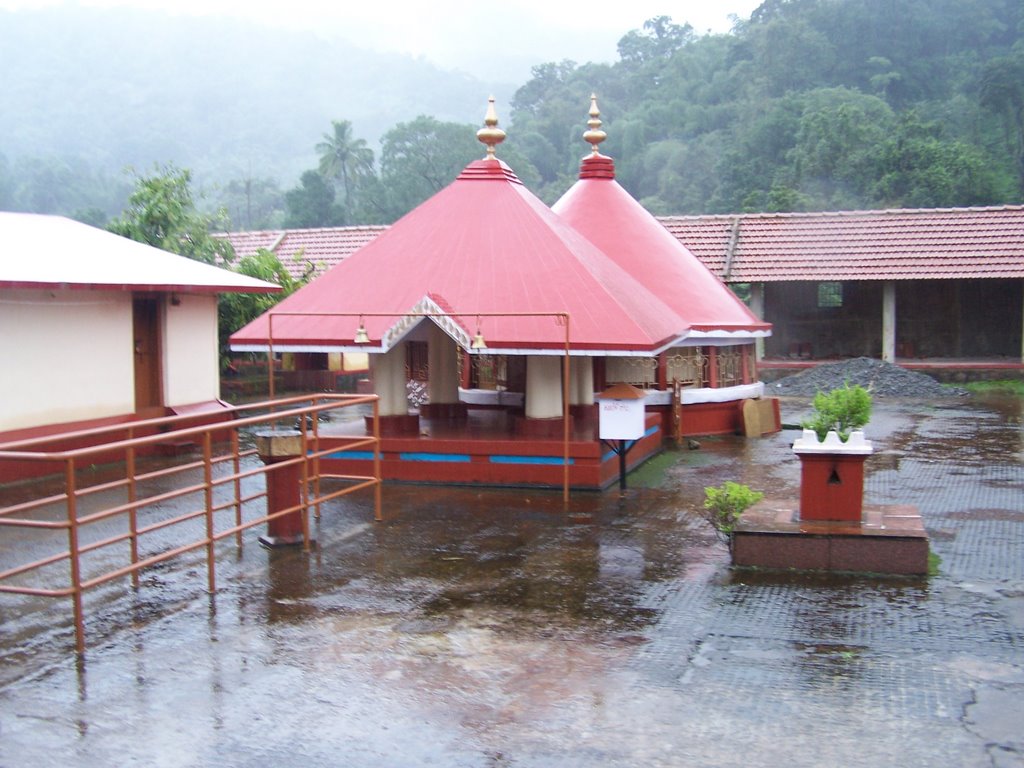
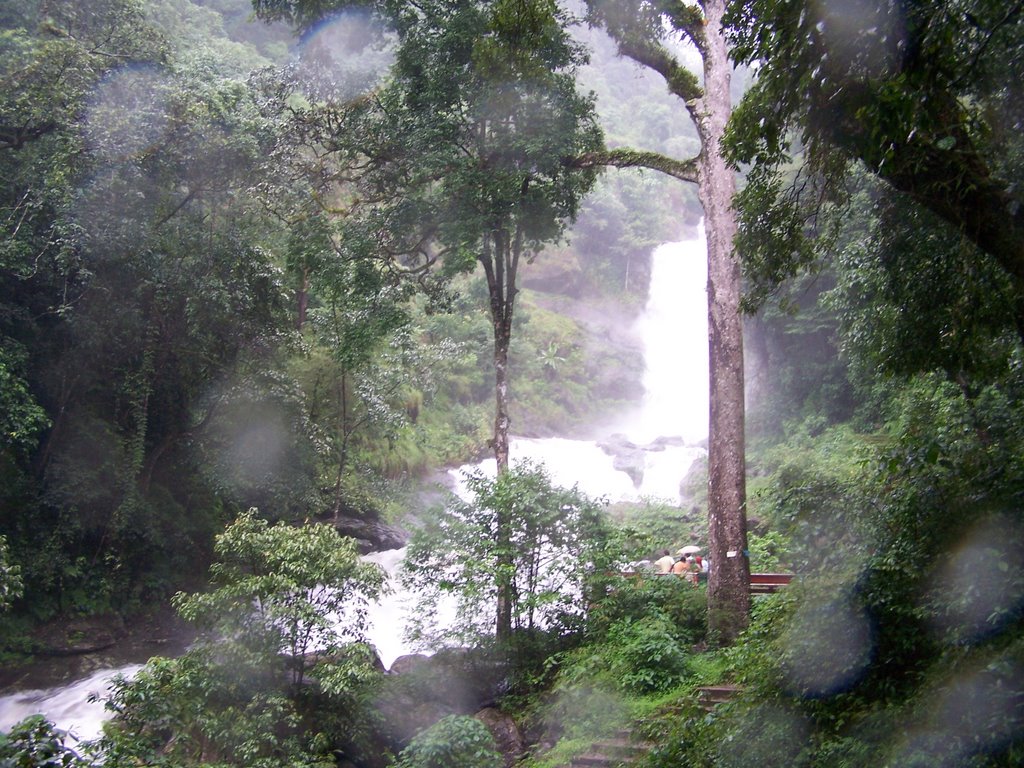
Last month
I took off on a weekend trip to IRUPU falls close to Nagarahole,Mysore.
Take a train to mysore and then a bus to Gonikoppal.Backtrack to Kuppa.The road via Nagarahole is BAD!
The rains made the falls very beautiful and it reminded me of the small Khad (stream) near where I stayed in the Himalayas.The trek is very small and suitable even for small kids to walk up.( you may have to keep a good hold on them, it is still a dangerous water place)
Ladies walked up in slippers and it rained all the time.A small temple to shiva is on the road at the beginning of the walk.It is called laksmana thirtha and there is a side trek route leading to the Brahmagiri wild life santuary.( It was closed for the rains).
We stayed at a homestay called Ramcad guest house.They have a shop in kuppa which sells all concievable eats and packets of rusks, bread and biscuits.The owners- two brothers will graciously ferry you in cars or jeeps to thier home.You dont exactly live in the main house but in small outer rooms attached to the main building.
On the whole its good for a weekend break without NEWS OR TV!
Monday, August 28, 2006
On creativity
On Creativity
I have been often told that I am creative. I get this compliment for all these occasions.
• I made left over bread slices into bread pakoda.
• Copied and painted a pretty flower from a book on to a table cloth.
• Designed a brochure with a template from a computer program.
• Learnt how to rip music on my own.
• Made wasted CDs into coasters
We think these people / non people are creative-
• Scientists who invent and discover stuff
• God
• Artists
• Writers
• Cooks
• Business men
What makes them creative is the fact that each of them accomplished something that was new or never there before.
Creativity is when the product is greater than its sum of the total parts. Sometimes I also think the product serves a function in a unique way, it does not just create a new function but opens up a whole new world of possibility. Look at the words we associate with creativity- out of the box, beyond limits, imagination.
It gives us a feeling of creating something real out of nothing. But not all new ideas are expressions of creativity.
“So novelty is not enough. Something creative must also have some value relative to what already exists and what is perceived as being needed. (Note that this, and all the foregoing discussion, focuses on what might be called "intellectual" or "technological" or "practical" creativity, whereas there is, of course, another dimension of value that has little to do with practicality and perhaps not much more to do with intellectuality, and that is artistic creativity. Here one of the criteria of value is aesthetic value, an affective or emotional criterion that will turn out to resurface unexpectedly even in intellectual creativity”.
What we can also say about artistic creativity is that even the value of what is determined by whatever is regarded as aesthetic for a particular set of people.
When I put together a papier-mâché sculpture that didn’t mean anything and looked quite ugly on my table –
This is the conversation that followed –
My Aunt
What is this for?
Nothing.
Long pause, while I rearranged it.
Is it modern art?
No.
Pause.discomfort.
Where did you get the paint from?
Well, Gangarams.
Are you taking Classes?
No!
My psychologist friend-
It’s a good way to vent your frustration!
(Well, They are a bit more relaxed but still uncomfortable)
My friend -
It’s nice you do all these things. This is nice. (It was not by any standard, it was ugly).
My Husband
What ever this is its great becoz you did it (He is married to me for 7 years and knows that he may not say anything else)
These conversations demonstrate that the world of creations needs function.
Now to God’s creation- Nature. Or self made creation called the natural world. Someone whom we try to imitate. I am looking at creativity if it is just important or adaptation. Is it a kind of biological adaptation to an environment- intellectual or even for survival.
An ability to fit unsuitable, limited spaces and make them utilizable. Only those projects are creative which have had limits on them.
More thoughts next blog.
I have been often told that I am creative. I get this compliment for all these occasions.
• I made left over bread slices into bread pakoda.
• Copied and painted a pretty flower from a book on to a table cloth.
• Designed a brochure with a template from a computer program.
• Learnt how to rip music on my own.
• Made wasted CDs into coasters
We think these people / non people are creative-
• Scientists who invent and discover stuff
• God
• Artists
• Writers
• Cooks
• Business men
What makes them creative is the fact that each of them accomplished something that was new or never there before.
Creativity is when the product is greater than its sum of the total parts. Sometimes I also think the product serves a function in a unique way, it does not just create a new function but opens up a whole new world of possibility. Look at the words we associate with creativity- out of the box, beyond limits, imagination.
It gives us a feeling of creating something real out of nothing. But not all new ideas are expressions of creativity.
“So novelty is not enough. Something creative must also have some value relative to what already exists and what is perceived as being needed. (Note that this, and all the foregoing discussion, focuses on what might be called "intellectual" or "technological" or "practical" creativity, whereas there is, of course, another dimension of value that has little to do with practicality and perhaps not much more to do with intellectuality, and that is artistic creativity. Here one of the criteria of value is aesthetic value, an affective or emotional criterion that will turn out to resurface unexpectedly even in intellectual creativity”.
What we can also say about artistic creativity is that even the value of what is determined by whatever is regarded as aesthetic for a particular set of people.
When I put together a papier-mâché sculpture that didn’t mean anything and looked quite ugly on my table –
This is the conversation that followed –
My Aunt
What is this for?
Nothing.
Long pause, while I rearranged it.
Is it modern art?
No.
Pause.discomfort.
Where did you get the paint from?
Well, Gangarams.
Are you taking Classes?
No!
My psychologist friend-
It’s a good way to vent your frustration!
(Well, They are a bit more relaxed but still uncomfortable)
My friend -
It’s nice you do all these things. This is nice. (It was not by any standard, it was ugly).
My Husband
What ever this is its great becoz you did it (He is married to me for 7 years and knows that he may not say anything else)
These conversations demonstrate that the world of creations needs function.
Now to God’s creation- Nature. Or self made creation called the natural world. Someone whom we try to imitate. I am looking at creativity if it is just important or adaptation. Is it a kind of biological adaptation to an environment- intellectual or even for survival.
An ability to fit unsuitable, limited spaces and make them utilizable. Only those projects are creative which have had limits on them.
More thoughts next blog.
Saturday, June 10, 2006
what I did

Here is a cool link to what I did before I did this blogging stuff
My Bro, has written this cool piece about our life in a forest , it always helps to have two perceptives on the same thing. Mine will come along.
any way read my life text( our life text!) at
http://www.everything2.com/index.pl?node_id=1479791
today is today because there is a tomorrow and there was a yesterday!
Love
Mansi
Wednesday, April 26, 2006

random vents
Ten people sitting around in a hot and sultry room all engaged in highly intellectuals thoughts cannot agree to form a body of responsible people with laws
people give up villains called tea or coffee and you wonder what the fuss is about
old ghosts come back to haunt you again and again till they are laid to rest
but also can be dug up so they need to be cremated.
one can get paid for writing rubbish-the question is does one want money so desperately.
experiments in consciousness writing dont work well for a Phd student-
Thats all
people give up villains called tea or coffee and you wonder what the fuss is about
old ghosts come back to haunt you again and again till they are laid to rest
but also can be dug up so they need to be cremated.
one can get paid for writing rubbish-the question is does one want money so desperately.
experiments in consciousness writing dont work well for a Phd student-
Thats all
Monday, March 13, 2006
Detoxing adventures1
Decided to detox
Day one
had salad for lunch
organic ,of course. dished by Naamdhari.Lots of veggies.and spourts.
Will have Tea apple and cinanammon. Dieting is expensive.
not feeling very hungry
Am not drinking too much water and am craving for solid food.Day one I think is toughest.Why am I doing this?
Just so
To see if I can.
If a yoga teacher cant detox who can?
Day one
had salad for lunch
organic ,of course. dished by Naamdhari.Lots of veggies.and spourts.
Will have Tea apple and cinanammon. Dieting is expensive.
not feeling very hungry
Am not drinking too much water and am craving for solid food.Day one I think is toughest.Why am I doing this?
Just so
To see if I can.
If a yoga teacher cant detox who can?
Friday, March 10, 2006
Fauna and Fun
Goats
On the small trek to Chetlayam falls we heard lots of drums.Kerala drums. The sound was keeping to a good beat,and me and my husband thought that they were good students practicingunder a teacher or some dance drama was going on. The sound receded and grew loud by turns and echoed off the mountain.As we began to speculate on the place where the sound was coming from, I saw three goats or to be specific- an ewe and her two kids.( Baby goats are called kids- look it up) and as I held out my hand she thought I was some strange new food and moved closed to eat my clothes . "Shoo!" I said . Then she shooed. and on here neck a wooden bell. Like in a mystery movie where the sounds all join and become louder, the drums grew louder! they were not drums said my sensibility, they were wooden bells on the neck of all the grazing animals. and as the cow or goat cropped the grass it went dub dub takda.No exotic drum ceremony only cows and goats.
On the way back I asked the little shop at the end of the road- wooden bell for cow? "No" he said in broken English. "Order and I make in month".
Both drums and wooden bells dont come by that easy.
Goats maybe do.
Since you have to read my blog,
here is a bad limmerick attempt-
A young woman called mansilight,
thought that her ears were allright,
Drums she heard,while watching birds,
They turned out to be wooden bells on sight!!
On the small trek to Chetlayam falls we heard lots of drums.Kerala drums. The sound was keeping to a good beat,and me and my husband thought that they were good students practicingunder a teacher or some dance drama was going on. The sound receded and grew loud by turns and echoed off the mountain.As we began to speculate on the place where the sound was coming from, I saw three goats or to be specific- an ewe and her two kids.( Baby goats are called kids- look it up) and as I held out my hand she thought I was some strange new food and moved closed to eat my clothes . "Shoo!" I said . Then she shooed. and on here neck a wooden bell. Like in a mystery movie where the sounds all join and become louder, the drums grew louder! they were not drums said my sensibility, they were wooden bells on the neck of all the grazing animals. and as the cow or goat cropped the grass it went dub dub takda.No exotic drum ceremony only cows and goats.
On the way back I asked the little shop at the end of the road- wooden bell for cow? "No" he said in broken English. "Order and I make in month".
Both drums and wooden bells dont come by that easy.
Goats maybe do.
Since you have to read my blog,
here is a bad limmerick attempt-
A young woman called mansilight,
thought that her ears were allright,
Drums she heard,while watching birds,
They turned out to be wooden bells on sight!!
Wednesday, February 15, 2006
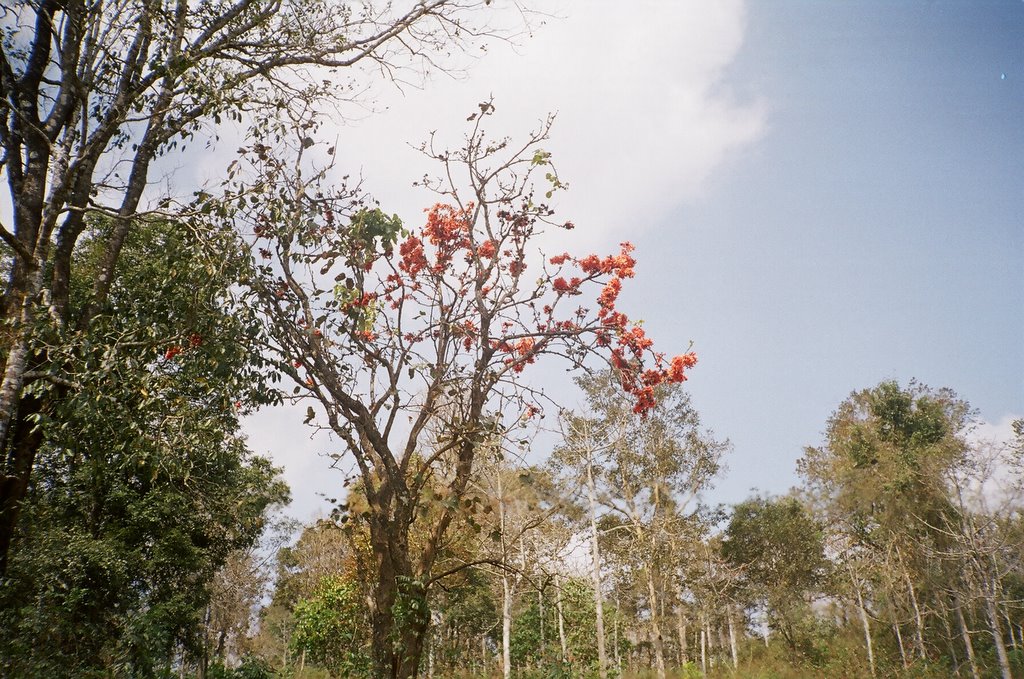
Today
Just dip your nose and dive into a rose and smell the flower
today take off your shoes and walk on the cool green grass
today just enjoy water running down your throat
today feel the earlymorning sunlight on your skin
what do we wait for- some day?
Some day never comes
all you have in eternity is TODAY!
I just did all that today and just allowed myself to be!
sometimes a good cup of tea can teach you more about life than the whole volumes of thought. all you have to do is give in to the experience of drinking that tea .
Friday, February 10, 2006
talking greek
There has been this big do at our institute. International relationships etc.
There was this one senior diplomat who said that the point of friction was the lack of cultural communication.Though all countries spoke English-the interpretation was totally a cultural phenomenon.I agree. 'Yo' to a US person is hello. 'Yo' in Tamil is like hey you (@#$%^&*) not invective but would imply some degree of annoyance.
another professor remarked in another conversation that the mountain people all have a way of greeting that is a peculiar narrative style .They start by asking for a story- whats the story. something like "Kya kahani hai ?" in hindi. They also begin a reply with Eisa hai na ......
Which brings me to the subject of languages.
I am going in for french classes from Monday.
on a lighter note
check out this quiz that I picked from another blog coder or killer
http://www.malevole.com/mv/misc/killerquiz/
I scored 8/10. Shows my psychology background .
There was this one senior diplomat who said that the point of friction was the lack of cultural communication.Though all countries spoke English-the interpretation was totally a cultural phenomenon.I agree. 'Yo' to a US person is hello. 'Yo' in Tamil is like hey you (@#$%^&*) not invective but would imply some degree of annoyance.
another professor remarked in another conversation that the mountain people all have a way of greeting that is a peculiar narrative style .They start by asking for a story- whats the story. something like "Kya kahani hai ?" in hindi. They also begin a reply with Eisa hai na ......
Which brings me to the subject of languages.
I am going in for french classes from Monday.
on a lighter note
check out this quiz that I picked from another blog coder or killer
http://www.malevole.com/mv/misc/killerquiz/
I scored 8/10. Shows my psychology background .
Tuesday, February 07, 2006
My Philosophy
This Blog is for my co aspirants to read.
Everytime you will find something to think,reflector ask yourself about. This is My spirit sharing blog .
So here is my motto of life
Be a light into yourself
Here a question-
Whats a miracle?
Think
Everytime you will find something to think,reflector ask yourself about. This is My spirit sharing blog .
So here is my motto of life
Be a light into yourself
Here a question-
Whats a miracle?
Think
Saturday, February 04, 2006
Jethro Tull and Neural networks
They played to a rather subdued audience in Bangalore. The show was well managed ( after all it was at the indian institute of management.
Did you know they once opened for pink flyod?
Today I sat through some papers presentations on neuroscience.Suddenly a wave of dissapointment washed over me- that all it all boils down to, our hopes fears, dreams and all the things we do even the Joy of Jethro Tull -nerve synapses. Then a speaker said that the number of nerve synapses possible in the brain is greater than all fundamental particles in the universe! Phew!
Also did you know that when we use verbs,the motor area of our brain lights up?Makes me think about ahimsa- the principle of Nonviolence . We are told not be violent in thought, word and action. If our motor area gets activated by mere verbs, it is possible that anything we think or would also result in a unexpressed action wont it?very difficult to practise I presume.
Did you know they once opened for pink flyod?
Today I sat through some papers presentations on neuroscience.Suddenly a wave of dissapointment washed over me- that all it all boils down to, our hopes fears, dreams and all the things we do even the Joy of Jethro Tull -nerve synapses. Then a speaker said that the number of nerve synapses possible in the brain is greater than all fundamental particles in the universe! Phew!
Also did you know that when we use verbs,the motor area of our brain lights up?Makes me think about ahimsa- the principle of Nonviolence . We are told not be violent in thought, word and action. If our motor area gets activated by mere verbs, it is possible that anything we think or would also result in a unexpressed action wont it?very difficult to practise I presume.
Wednesday, February 01, 2006
And where was I yesterday?
Well searching the city book stores for Kant's critique of pure reason.
Who is Kant?
A philosopher.
What did he say mainly?
Lots of stuff.
Let me figure it out.
(if you are impatient read Wiki on it)
Bangalore is a starved city Philosophy wise.
Want to know what outsourcing and software is doing to us ?
There was a 10% off on computer books and no discount on philosophy!and the comp guys are richer!
I was wandering the bookidors( Book + Corridors) and I saw a book that said Python. I rushed to check on this wildlife and found it was a code.Very funny . A python may be sitting in this very blog program.Heh Heh. But I think it will be some Vague thingageek language like C++ ++
or javascript.My bro who is a programmer may kill me if he sees this blog,hey but who is afraid of virtual geeks!
A philosopher can laugh at death.
Check this out from Kant-
Kant says that appearences of objects are dependent on Apriori intuitions called space and time. Space and time donot inhere in objects but are part of the sensibility of all thinking humans that helps us order the universe.
okay thats a simple version! I do have some humane values you know.You dont have to go through my penance.
Back to my book . Its on the net so I have to read off a screen. Immensely hard .Specially philosophy if you need to turn pages back and forth to understand.
Blogging is good. It helps me write nonphilosophically and I know I am not being graded!!!!
Jethro tull is playing in Bangalore on friday and I hope to go.
Hope to blog more coherently tommmooorrrow.
Who is Kant?
A philosopher.
What did he say mainly?
Lots of stuff.
Let me figure it out.
(if you are impatient read Wiki on it)
Bangalore is a starved city Philosophy wise.
Want to know what outsourcing and software is doing to us ?
There was a 10% off on computer books and no discount on philosophy!and the comp guys are richer!
I was wandering the bookidors( Book + Corridors) and I saw a book that said Python. I rushed to check on this wildlife and found it was a code.Very funny . A python may be sitting in this very blog program.Heh Heh. But I think it will be some Vague thingageek language like C++ ++
or javascript.My bro who is a programmer may kill me if he sees this blog,hey but who is afraid of virtual geeks!
A philosopher can laugh at death.
Check this out from Kant-
Kant says that appearences of objects are dependent on Apriori intuitions called space and time. Space and time donot inhere in objects but are part of the sensibility of all thinking humans that helps us order the universe.
okay thats a simple version! I do have some humane values you know.You dont have to go through my penance.
Back to my book . Its on the net so I have to read off a screen. Immensely hard .Specially philosophy if you need to turn pages back and forth to understand.
Blogging is good. It helps me write nonphilosophically and I know I am not being graded!!!!
Jethro tull is playing in Bangalore on friday and I hope to go.
Hope to blog more coherently tommmooorrrow.
Tuesday, January 31, 2006
trip to wynad-a guide for the perplexed
Searching for Wyanad
First of all there is no wyanad actually .So don't go looking for trains and buses to Wyanad.Wyanad is the general name of a region in Kerala.Wyanad is off the major tourist circuit and is good for backpacking or the very luxurious traveller. If you dont like walking or cannot afford to pay 5000 Rs(500$ aprox) ,per person per night, this may just be where you dont want to be.There are hideaway resorts with amazing facilities like tree houses or ayurvedic spas called Tranquil, Vythiri or Greengates etc etc ,where I didnt go of course.
To get there
The easiest route is from Mysore.Take a bus to Sultan Battery. Say Buth-eh-reee not battery.It was originally named because of the gun that Tipu Sultan had there.
There are three small towns that can be your night halts from where you explore smaller trips and treks (all half to a day long)- Sultan Bathery,Kalpetta,Manathvady. Lots and lots of local buses at all times.Ask around.
This trip I stayed at Sultan Battery for a night halt.
Accomodation
Chakalakkal ( I not sure of the spelling)guest house- modest budget hotel. Not to many TVS or AC room. No eatery on premisis. Not expensive.
Dwaraka tourist home- Modest again but has a next door resturant called Prince. (For the women traveller- check out for the Family room in most eateries ,you will be less stared at)
ask to be given a room in the New annex. If you are finicky about peeling paint or dust on the walls-try the next one. If you have made your peace with old stuff and dont mind faded stuff and dusty shelves go ahead.
The Resort(Issac's ) Very good for the price but book in advance. Clean white sheets and good resturant.(Room service takes a long time 30-45 minutes either for coffee or a full meal- their resturant is often full)
Ask for a wyanad brochure to borrow at hotel reception and get it xeroxed. You cant get copies.
Time for this trip.
Can be done in a weekend from Mysore, Bangalore or closer places.
To mysore from where ever
From mysore 3to 31/2 hour drive through tree lined curved road ( Calicut National highway) ooty road.
Reach before lunch. Do local sight seeing-the gun and a jain temple.
Next day take a bus to chetilayam -Beautiful bird watching zone- easy trek along a jeep track from the road about 6 kms to the head of the Chetilayam falls(wear a hat ,take water and food and no plastic please).Even smaller kids can do this trek quite easily. Local jeeps ply along now and then and so if you have no trek experience at all this can be a good start up.You cant lose your way here. keep walking till you see a bridge across a small stream and the large mango tree. you are close to the falls.
For more details on how to reach the actual falls, look up next blog on Fauna and Fun days.( Some time elephants cross into the road- heed local advice when they say "Yaane"( elephant) or "NOOKU"( see).If they smile when they say it ,proceed. if they wave and gesticulate wildly,keep away.This is a very good bird zone.even for late risers .
Do temple visits for the seetha temple and return to battery
Next day plan amabalavyal-
Get to Kolagapara and take auto to the Eddkal caves ( 150 rupees from SB to and fro with waiting)Till parking area( donot not walk there is a steep climb to the cave entrance and then a further scarmbling climb to the actual carved caves - a full cardio workout)
the caves are prehistoric 1500-1700 BC. with carvings . also the view is spectacular.Must see for history enthusiasts and people who like views from top.Dont miss the vertical -crack view from the far end of the cave.Bad for knee pain and vertigo
Karugahpuuaa dam nothing but good clean water and the dam( not worth it unless you havent seen Dams before
Heritage muesuem -recommended but it closes at 5 pm ( so I didnt get to see it)
if you dig gardens and agriculture check out the agricultural research centre of the kerala agricultural university ( during early jan-feb- march the roses in garden are spectacular.
More Journal stuff tomorrow.
First of all there is no wyanad actually .So don't go looking for trains and buses to Wyanad.Wyanad is the general name of a region in Kerala.Wyanad is off the major tourist circuit and is good for backpacking or the very luxurious traveller. If you dont like walking or cannot afford to pay 5000 Rs(500$ aprox) ,per person per night, this may just be where you dont want to be.There are hideaway resorts with amazing facilities like tree houses or ayurvedic spas called Tranquil, Vythiri or Greengates etc etc ,where I didnt go of course.
To get there
The easiest route is from Mysore.Take a bus to Sultan Battery. Say Buth-eh-reee not battery.It was originally named because of the gun that Tipu Sultan had there.
There are three small towns that can be your night halts from where you explore smaller trips and treks (all half to a day long)- Sultan Bathery,Kalpetta,Manathvady. Lots and lots of local buses at all times.Ask around.
This trip I stayed at Sultan Battery for a night halt.
Accomodation
Chakalakkal ( I not sure of the spelling)guest house- modest budget hotel. Not to many TVS or AC room. No eatery on premisis. Not expensive.
Dwaraka tourist home- Modest again but has a next door resturant called Prince. (For the women traveller- check out for the Family room in most eateries ,you will be less stared at)
ask to be given a room in the New annex. If you are finicky about peeling paint or dust on the walls-try the next one. If you have made your peace with old stuff and dont mind faded stuff and dusty shelves go ahead.
The Resort(Issac's ) Very good for the price but book in advance. Clean white sheets and good resturant.(Room service takes a long time 30-45 minutes either for coffee or a full meal- their resturant is often full)
Ask for a wyanad brochure to borrow at hotel reception and get it xeroxed. You cant get copies.
Time for this trip.
Can be done in a weekend from Mysore, Bangalore or closer places.
To mysore from where ever
From mysore 3to 31/2 hour drive through tree lined curved road ( Calicut National highway) ooty road.
Reach before lunch. Do local sight seeing-the gun and a jain temple.
Next day take a bus to chetilayam -Beautiful bird watching zone- easy trek along a jeep track from the road about 6 kms to the head of the Chetilayam falls(wear a hat ,take water and food and no plastic please).Even smaller kids can do this trek quite easily. Local jeeps ply along now and then and so if you have no trek experience at all this can be a good start up.You cant lose your way here. keep walking till you see a bridge across a small stream and the large mango tree. you are close to the falls.
For more details on how to reach the actual falls, look up next blog on Fauna and Fun days.( Some time elephants cross into the road- heed local advice when they say "Yaane"( elephant) or "NOOKU"( see).If they smile when they say it ,proceed. if they wave and gesticulate wildly,keep away.This is a very good bird zone.even for late risers .
Do temple visits for the seetha temple and return to battery
Next day plan amabalavyal-
Get to Kolagapara and take auto to the Eddkal caves ( 150 rupees from SB to and fro with waiting)Till parking area( donot not walk there is a steep climb to the cave entrance and then a further scarmbling climb to the actual carved caves - a full cardio workout)
the caves are prehistoric 1500-1700 BC. with carvings . also the view is spectacular.Must see for history enthusiasts and people who like views from top.Dont miss the vertical -crack view from the far end of the cave.Bad for knee pain and vertigo
Karugahpuuaa dam nothing but good clean water and the dam( not worth it unless you havent seen Dams before
Heritage muesuem -recommended but it closes at 5 pm ( so I didnt get to see it)
if you dig gardens and agriculture check out the agricultural research centre of the kerala agricultural university ( during early jan-feb- march the roses in garden are spectacular.
More Journal stuff tomorrow.
Wednesday, January 25, 2006
I begin
I have been meaning to start blogging for ages and today's lazy afternoon is a perfectly good excuse. The next four days I am off surveying wyanad for a pilot study.What do Indians think of nature?I hope to chill and blog my journey.expect some nice photographs.
well I have this nice bit about rainwater harvesting in India by traditional means.
I have sourced this info from blogs,books and all manner of places.
I believe that since these are traditional methods there is no copy right.
so here goes-
A khadin, also called a dhora, is an ingenious construction designed to harvest surface runoff water for agriculture. Its main feature is a very long (100-300 m) earthen embankment built across the lower hill slopes below gravelly uplands. Sluices and spillways allow excess water to drain off. The khadin system is based on the principle of harvesting rainwater on farmland and subsequent use of this water-saturated land for crop production.
First designed by the Paliwal Brahmins of Jaiselmer, in the 15th century, this system has great similarity with the irrigation methods of the people of Ur (present Iraq) around 4500 BC and later of the Nabateans in the Middle East. A similar system was practiced 4,000 years ago in the Negev desert, and in southwestern Colorado 500 years ago.
I saw these kahadins in Jaiselmer when I went for a trip.
-From a old website that doesnot exist now!
Isnt that cool?
well I have this nice bit about rainwater harvesting in India by traditional means.
I have sourced this info from blogs,books and all manner of places.
I believe that since these are traditional methods there is no copy right.
so here goes-
A khadin, also called a dhora, is an ingenious construction designed to harvest surface runoff water for agriculture. Its main feature is a very long (100-300 m) earthen embankment built across the lower hill slopes below gravelly uplands. Sluices and spillways allow excess water to drain off. The khadin system is based on the principle of harvesting rainwater on farmland and subsequent use of this water-saturated land for crop production.
First designed by the Paliwal Brahmins of Jaiselmer, in the 15th century, this system has great similarity with the irrigation methods of the people of Ur (present Iraq) around 4500 BC and later of the Nabateans in the Middle East. A similar system was practiced 4,000 years ago in the Negev desert, and in southwestern Colorado 500 years ago.
I saw these kahadins in Jaiselmer when I went for a trip.
-From a old website that doesnot exist now!
Isnt that cool?
Subscribe to:
Posts (Atom)


